
Jump to | Watering Problems | Watering needs | Soil type impacts | Tools | Drought
How to water your garden
How much water does your garden need? It depends on the plants you grow, your soil, the weather, the time of year, and whether plants are newly planted or established.
Most UK gardeners don’t water new plants enough, and overwater established ones. Deep watering with time to dry out beats a light sprinkling every day. It's better for the plant and uses less water. Water the roots, not the leaves. This guide explains how to water effectively, recognise when plants need water, and adapt your watering to different conditions, including drought and hosepipe bans.
Quick facts
Morning or evening watering? Both have advantages. It depends whether you water the soil and roots, or water the leaves and flowers, see below for that advice. Evening watering is most water-efficient for root watering, with less evaporation giving more time for water to soak down to the roots. Morning watering is also very effective, and may be better if foliage and flower watering is unavoidable. The foliage and soil surface dry more quickly during the day. Prolonged leaf wetness can encourage some fungal diseases. Evening watering can also give slugs and snails more opportunity to feed, particularly on susceptible plants.
Watering in the full heat of the midday sun is also OK, but is usually the least water-efficient time, particularly if water is sprayed over the foliage. Don't automatically water a plant just because it wilts in the midday heat. Some plants naturally wilt temporarily as they lose water through transpiration faster than their roots can replace it, then recover when the temperature falls. Check the soil before watering. (See leaf scorch myth below.)
The leaves on a plant are designed for photosynthesis, not water absorption. Water gathering is the job of the plant’s root system. Watering leaves has very little impact on a plant’s wellbeing, and it just creates a large evaporation surface and wastes water. Water the ground around the roots. That’s where it’s needed, and it’s the most efficient use of your water and time.
Water deeply with time to dry out. For established plants, a thorough watering followed by time to dry out trains roots to grow downward, chasing the moisture. Deeper roots mean a more drought-resistant plant. Watering little and often keeps roots shallow, right where the soil dries out fastest.
New plants need extra care. They have not yet established an extensive root system and need regular watering to help them establish.
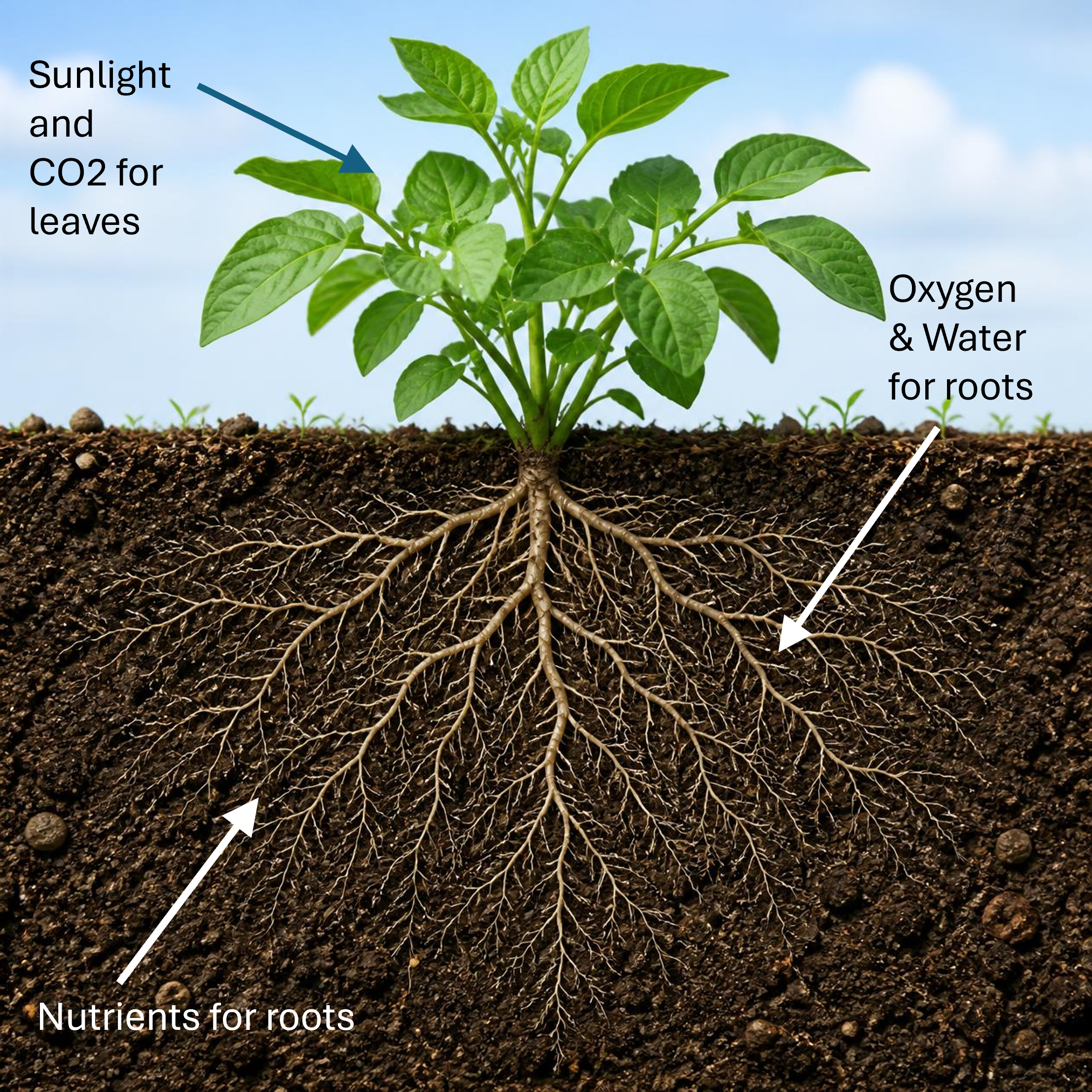
Roots need oxygen as well as water. Air spaces between soil particles supply oxygen to the roots. Keeping soil permanently saturated squeezes out the air and can suffocate roots, which is another reason to let soil dry between thorough waterings.
The finger dampness test: push a finger into the soil up to your second knuckle. Dry down there? Time to water. Cool and damp? Leave it — the roots are fine even if the surface looks parched.
Wilting isn't always a cry for help. Many plants droop a little at midday to conserve energy in the heat, then perk back up by evening. This is normal. Wilting first thing in the morning, before the day's heat has even started is a much stronger sign of drought stress.
Soil types change watering frequencies. Sandy soil drains quickly and needs more frequent watering. Clay holds water longer but can become waterlogged. Loam generally sits in the middle. See our Soil Knowledge page to understand your soil better.
Sprinklers are surprisingly wasteful. They can deliver water over areas where it isn't needed, and much of the water can be lost to evaporation. The RHS rates sprinklers as one of the least water-efficient ways to water a garden.
Containers play by different rules entirely. Restricted root space means pots and hanging baskets can need watering every single day in summer, even while beds and borders nearby need nothing at all.
Does water on leaves really scorch them in sunlight?
When there is a rain shower on a sunny day do we really need to rush into the garden and dry all the leaves to prevent scorching?
You will be relieved to know - you don’t. Leaf scorching from water droplets is a myth (Mostly). Extensive scientific testing has shown that for most plants, water droplets do not have the right shape or positioning to do any damage. The one exception is “hairy leaves” where the water droplet may be suspended above the leaf and in some situations may create a mark. So, what causes leaf scorch really? In most cases the brown marks on the leaves would have formed anyway from drought stress, whether you water the leaves or not. In some cases, plant fertiliser if mixed with the water can concentrate and cause burning. In most cases watering the leaves at the hottest part of the day is ineffective, but it won’t do any damage to the plant.
Jump to | Top of page | Watering needs | Soil type impacts | Tools | Drought
Watering Problems: What's Wrong With My Plant?
Yellowing leaves and wilting can mean too little water or too much. The symptoms overlap, so leaf colour alone isn't a reliable diagnosis. The one test that rarely lies: check the soil (see the finger test above), and feel the leaf itself. Crisp and dry points to underwatering. Soft and limp points to overwatering. Use the gallery below alongside that check.
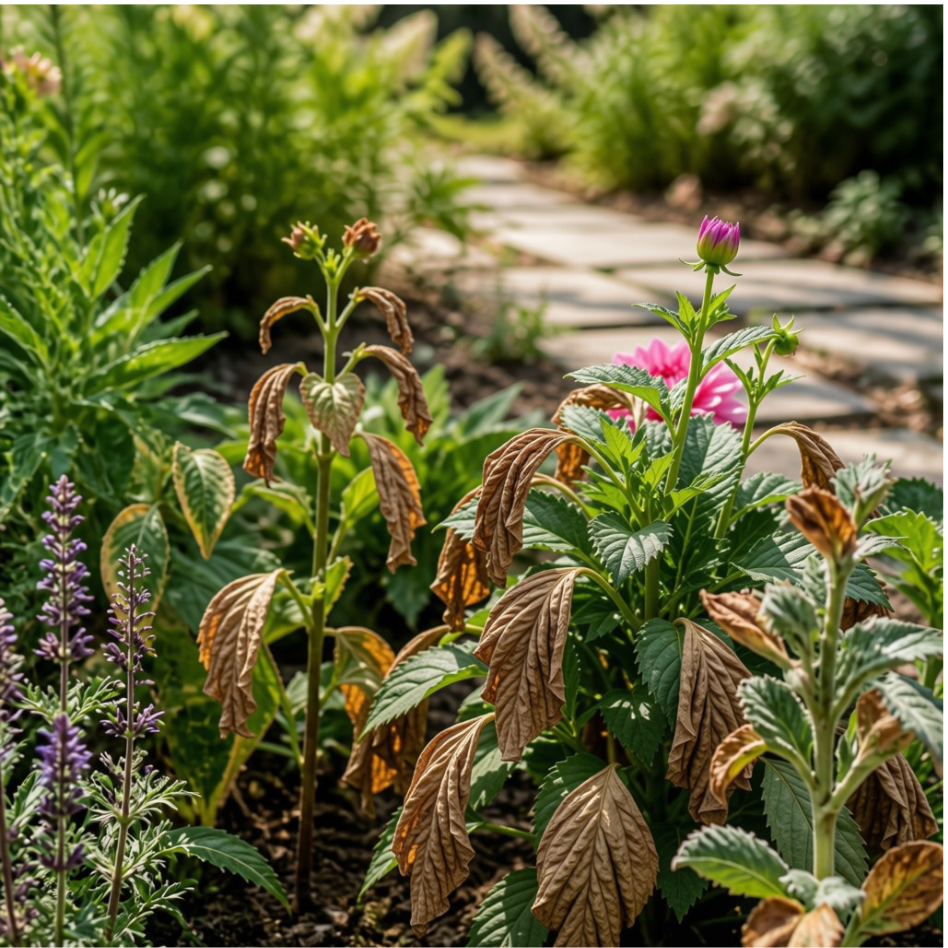
Underwatering (drought stress) - Leaves and stems feel dry, crisp and brittle. Leaf tips and edges often brown first, sometimes curling inward. Wilts, but may perk back up within a few hours of watering. In pots, soil may visibly shrink away from the container's sides. Growth slows, and flower buds may drop.
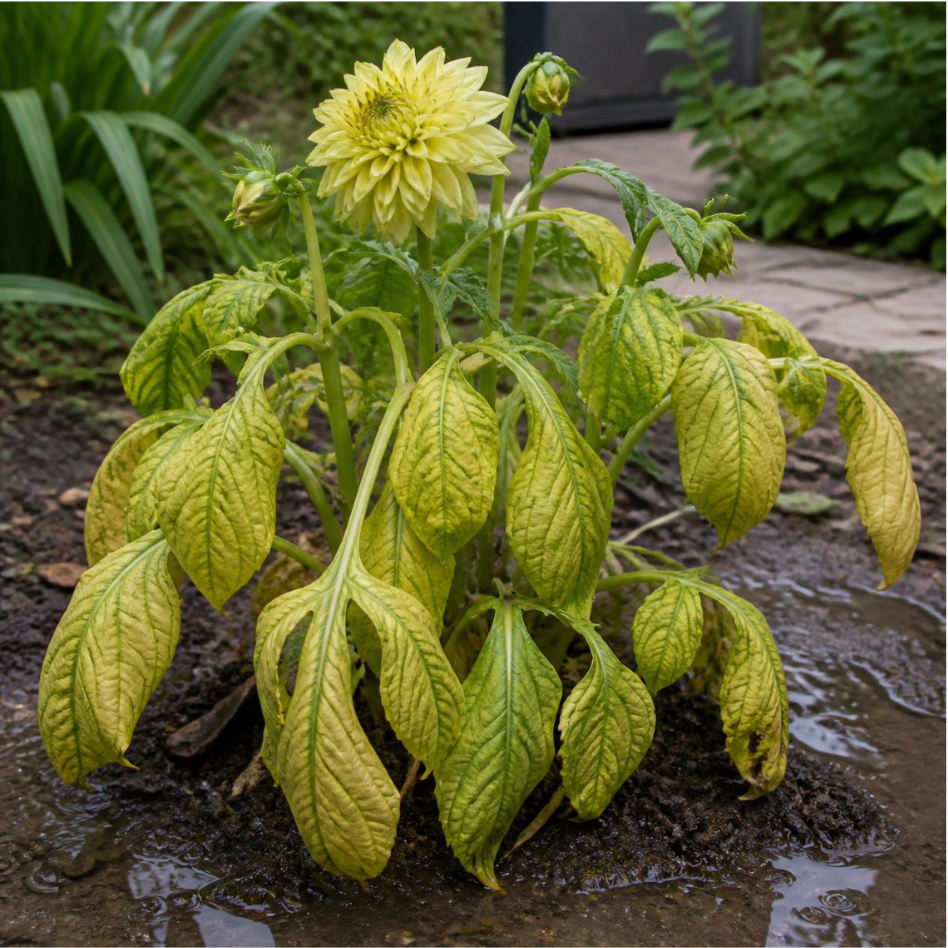
Overwatering (Root rot) - Leaves feel soft, limp and "mushy" rather than crisp — the key giveaway. Yellowing often starts with the older, lower leaves first. Wilting that does not recover even after more water is a red flag: the roots may have been damaged and can no longer take up water properly, so more watering only makes it worse. Stems near the soil may turn soft, dark and mushy, sometimes with a foul smell.
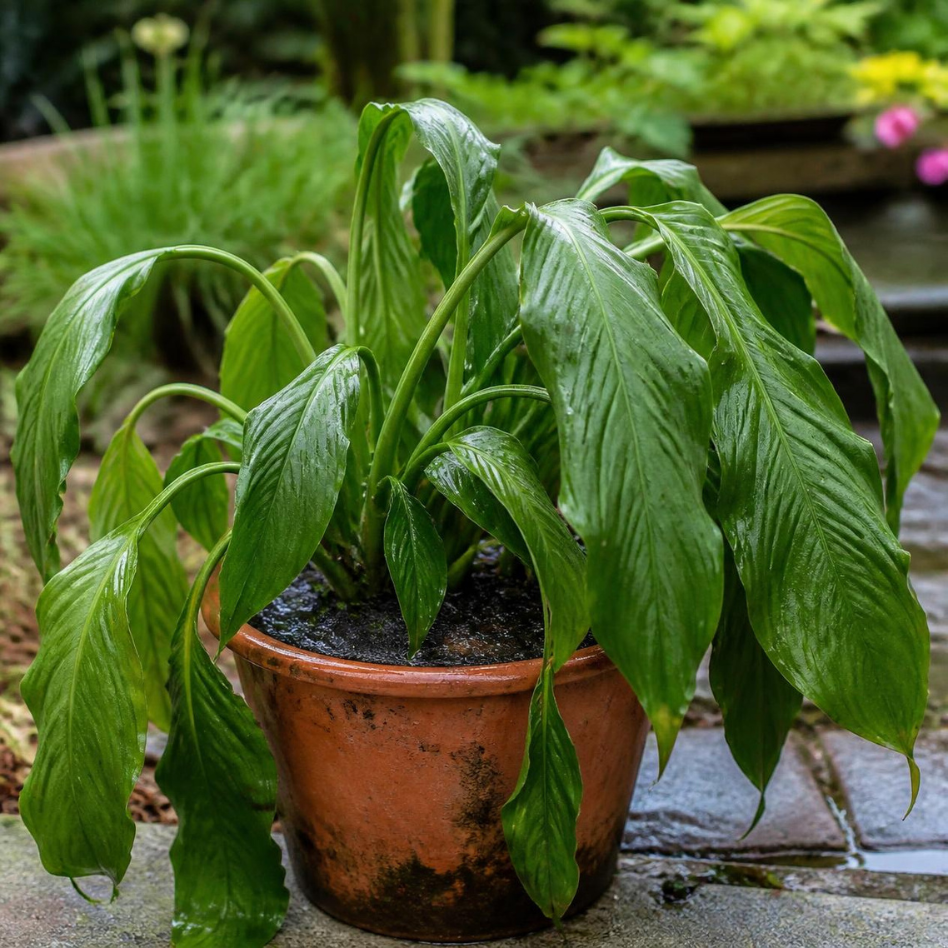
The overwatering paradox - A wilting plant sitting in soggy soil looks exactly like it needs water — but it's often drowning, not thirsty. Waterlogged soil pushes out the air roots need (see "roots need oxygen too," below), so the roots suffocate and start to rot. Rotted roots can't absorb water even though there's plenty in the soil — so the plant wilts from a genuine water shortage, caused by too much water. Always check the soil itself before responding to a wilting plant with more water.
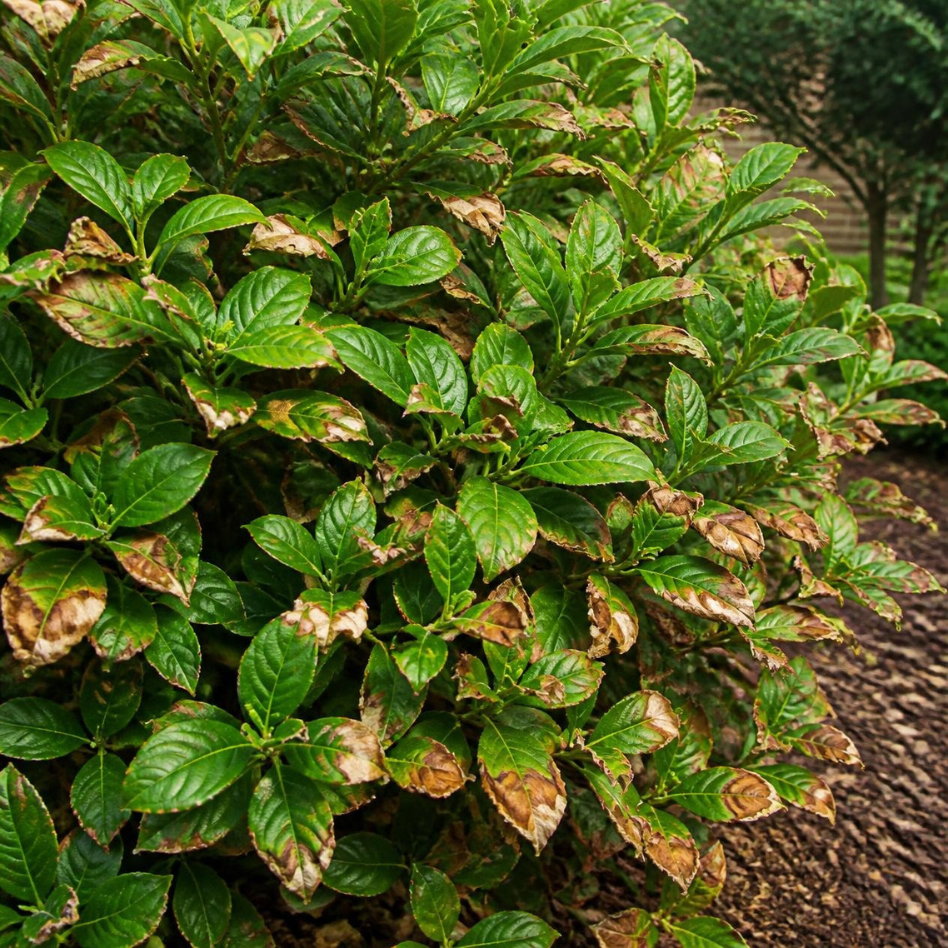
Leaf scorch (drought, heat, fertiliser damage) - Crisp, brown, papery patches, usually starting at the leaf margins or tips — dry to the touch, unlike overwatering's soft yellow-brown patches. Common causes include drought stress, strong wind, frost, or fertiliser applied too strongly or too close to the foliage. Not caused by watering leaves in sunshine — see the full myth-bust above.
Why plants need Oxygen, how they get it, and how they use it.
We have all been told that plants absorb CO2 and give out O2. That’s correct, and is a fundamental part of photosynthesis that creates the plants food (sugars). What’s not so widely known is that the plant cells burn these sugars using O2 to fuel growth, and also emit CO2! This means the plant cells also need a steady supply of oxygen to grow. The roots buried in the soil need to find that oxygen from somewhere in the soil. They draw it in from the gaps between soil particles. That works best when those gaps aren't permanently flooded with water. Soil that's kept constantly wet squeezes the air out, effectively suffocating the roots, paradoxically making them less able to absorb the essential water. This is another reason deep infrequent watering beats a daily light sprinkle: it lets the soil breathe between drinks
Jump to | Top of page | Watering Problems | Soil type impacts | Tools | Drought
Which Plants Need the Most Water — and Which Barely Need Any?
A quick rule of thumb before the lists: fleshy, soft, green leaves generally mean a plant wants moisture. Small, grey, silvery, or strongly aromatic leaves (lavender, rosemary, thyme, sage) usually mean the opposite — many drought-tolerant plants evolved those traits specifically to survive on very little water, either reflecting harsh sun or trapping moisture close to the leaf. It's not a perfect rule, but it's a genuinely useful first guess when you're not sure about an unfamiliar plant.
Thirsty plants — keep these well watered
Hydrangeas — will wilt dramatically and quickly when dry
Hostas, astilbes, many ferns — all naturally woodland/streamside plants, need consistently moist soil
Camellias, azaleas, rhododendrons — ericaceous (acid-loving) shrubs that dislike drying out, especially while establishing; Trehane Nursery in our Plant Suppliers guide specialises in exactly these
Rhubarb — commonly assumed to be tough since it's so hardy in every other respect, but the RHS is clear that a dry summer stunts growth and gives "poorly-coloured, bad-tasting stalks." Don't let its toughness fool you.
Bee balm (Monarda) — a sneaky one: dry roots in summer can contribute to powdery mildew on this plant, which usually gets blamed on humidity instead of drought stress
Runner beans, courgettes, tomatoes, lettuce — most productive fruiting and leafy vegetables need steady moisture, especially once flowering/fruiting begins
Sweet peas — need regular moisture right through the season, especially once they start flowering
Anything in a container or hanging basket — regardless of the plant itself, restricted root space (see Quick Facts above) means daily watering in summer is often needed
Drought-tolerant plants — can cope with far less
Lavender, rosemary, thyme, sage — Mediterranean herbs from dry hillsides, and arguably taste better for a lean, dry site rather than a pampered one
Cistus (rock rose), Salvia, Perovskia (Russian sage) — reliable, attractive, genuinely low-water performers, several RHS Award of Garden Merit varieties among them
Sedum, Euphorbia, Achillea (yarrow) — tough, drought-hardy perennials for a sunny border
Agapanthus — copes well with dry spells once established, particularly the hardier deciduous varieties
Ornamental grasses (many varieties) — generally low water need once established
Silver/grey-leaved plants generally (Stachys/lamb's ear, Artemisia) — the leaf colour itself is often a genuine clue, per the rule of thumb above
Drought-tolerant annuals: sunflowers, cosmos, zinnia — once established, useful for filling gaps or containers without adding much to your watering round.
Jump to | Top of page | Watering Problems | Watering needs | Tools | Drought
How Your Soil Type Changes Your Watering
One of the biggest factors determining how often and how much you need to water is the soil type in your garden. See our Soil Knowledge page to help identify your soil type, Clay holds water well but can bake hard in summer and waterlog in winter, so it needs watering less often but more thoroughly each time. Sandy soil drains fast and holds almost nothing, so it needs watering more often, in smaller amounts. Loam sits in between and is the easiest to get right. Chalk behaves much like sand — free-draining and often drought-prone.
See the soil knowledge page for more details on identifying and working with different soil types. The charts below show the moisture levels for both drought resistant and thirsty plants for 3 different soil types- Sandy, Loam and Clay. The upper dotted blue line is the soils water holding capacity. Above this the soil is considered waterlogged. The lower dotted red line is the wilting point. Below this, your plants are at risk of drought damage over time.
Plant water requirements usually drop off during Winter, just when we have the most rain! The winter ranges shown in these charts are practical estimates rather than precise measurements, because there is much less published data on dormant-season water demand. In practice, established plants usually take up very little water during dormancy, and avoiding prolonged waterlogging is often more important than supplying additional water. Fortunately during the dormant season (from roughly October to March) plants mostly tolerate higher levels of waterlogging and drought.
A soil moisture meter can give a useful indication of moisture levels. As a quick easy test, push your finger into the soil up to about the second knuckle. If the ground is damp at that depth, all is well. If not, it’s time to water.
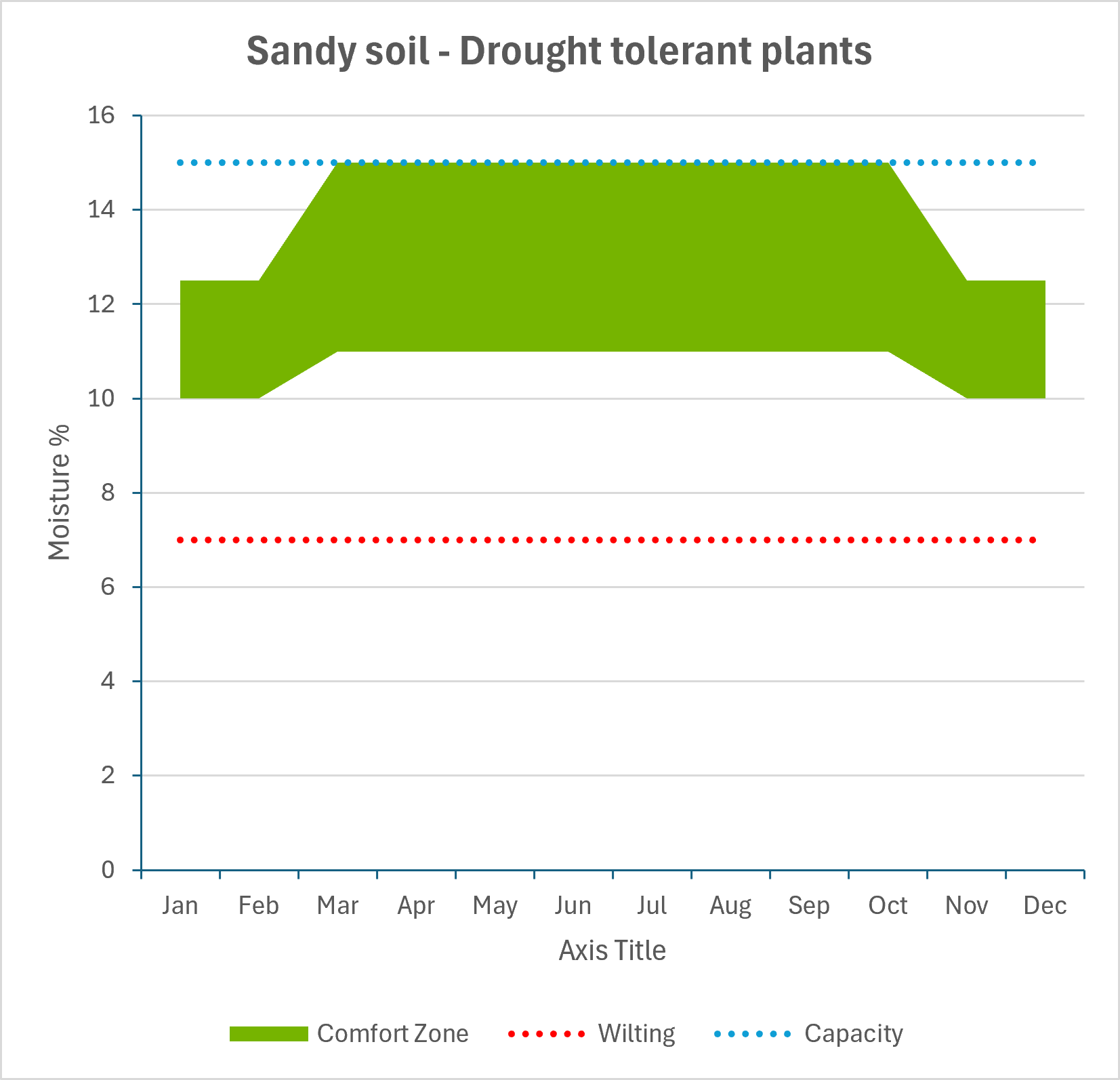
Sandy soil drains quickly, so even drought-tolerant plants need watering more often than they would in heavier soil. The green band shows the comfortable moisture range; the red line is the wilting point and the blue line shows the soil's water-holding capacity.
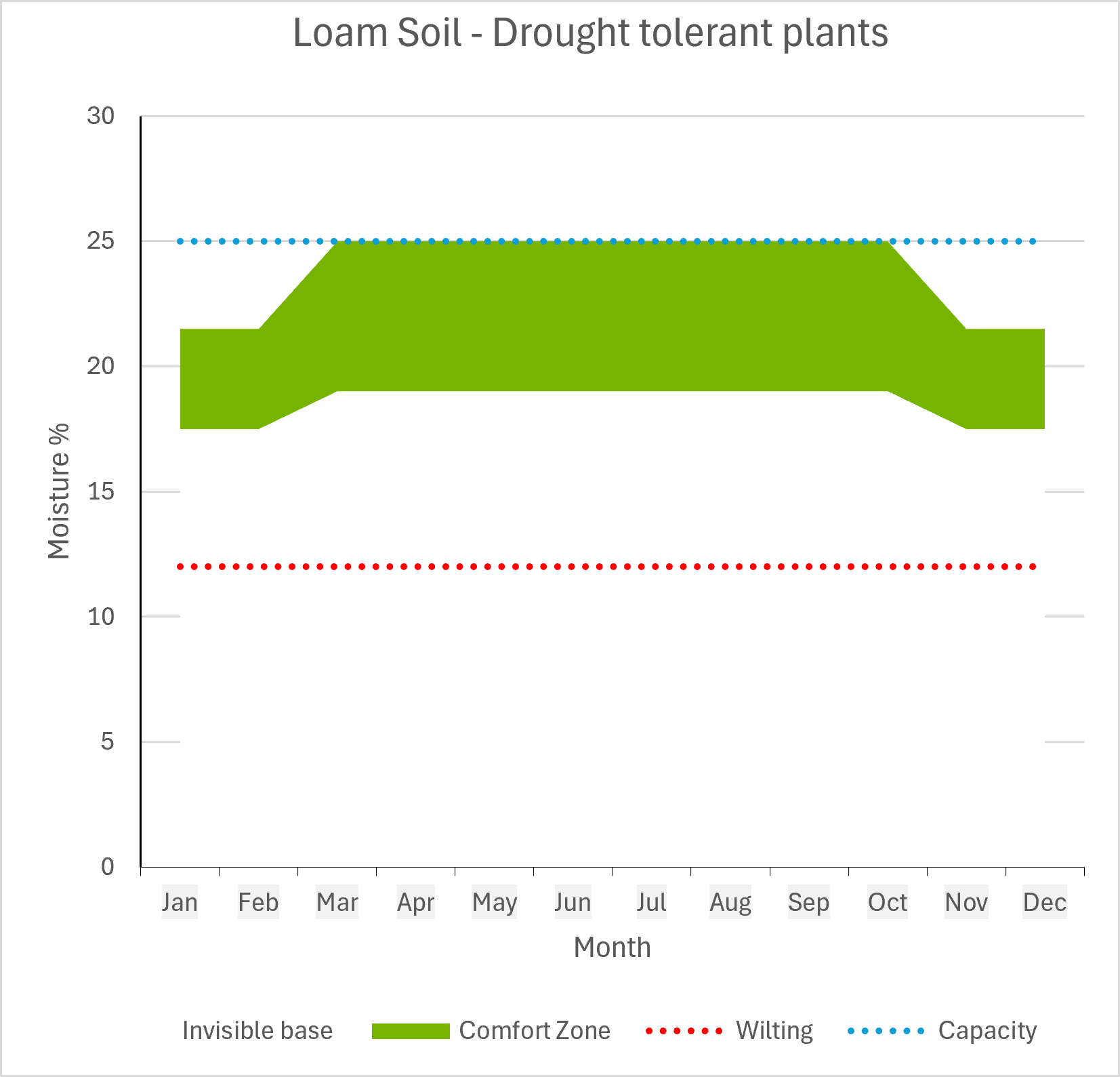
Loam holds more water than sandy soil, so drought-tolerant plants generally need watering less often. The green band shows the comfortable moisture range; the red line is the wilting point and the blue line shows the soil's water-holding capacity.
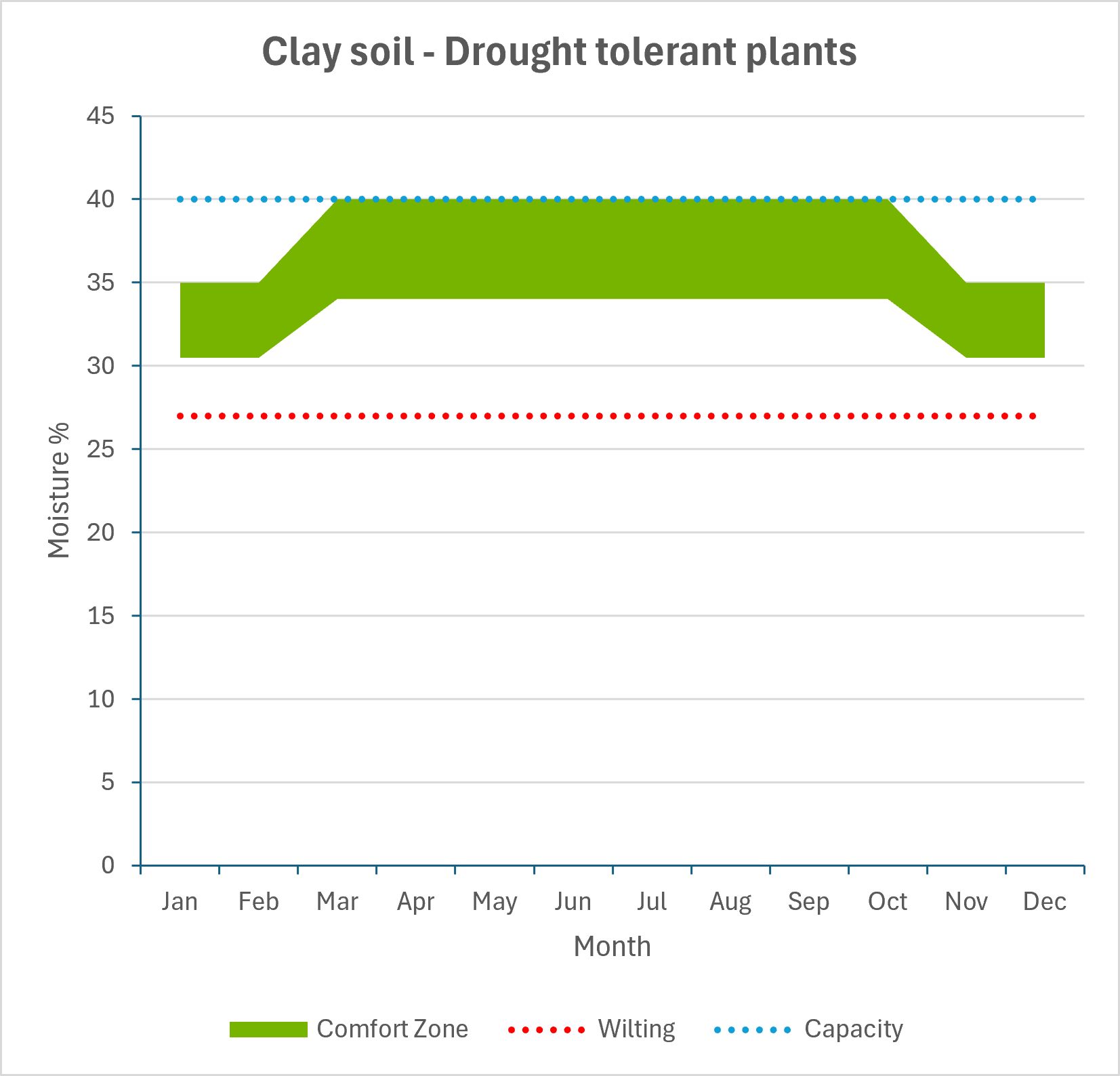
Clay soil holds much more water than sandy soil, so drought-tolerant plants can usually go longer between waterings. Water slowly and thoroughly when needed, giving the water time to penetrate the soil rather than running off the surface.
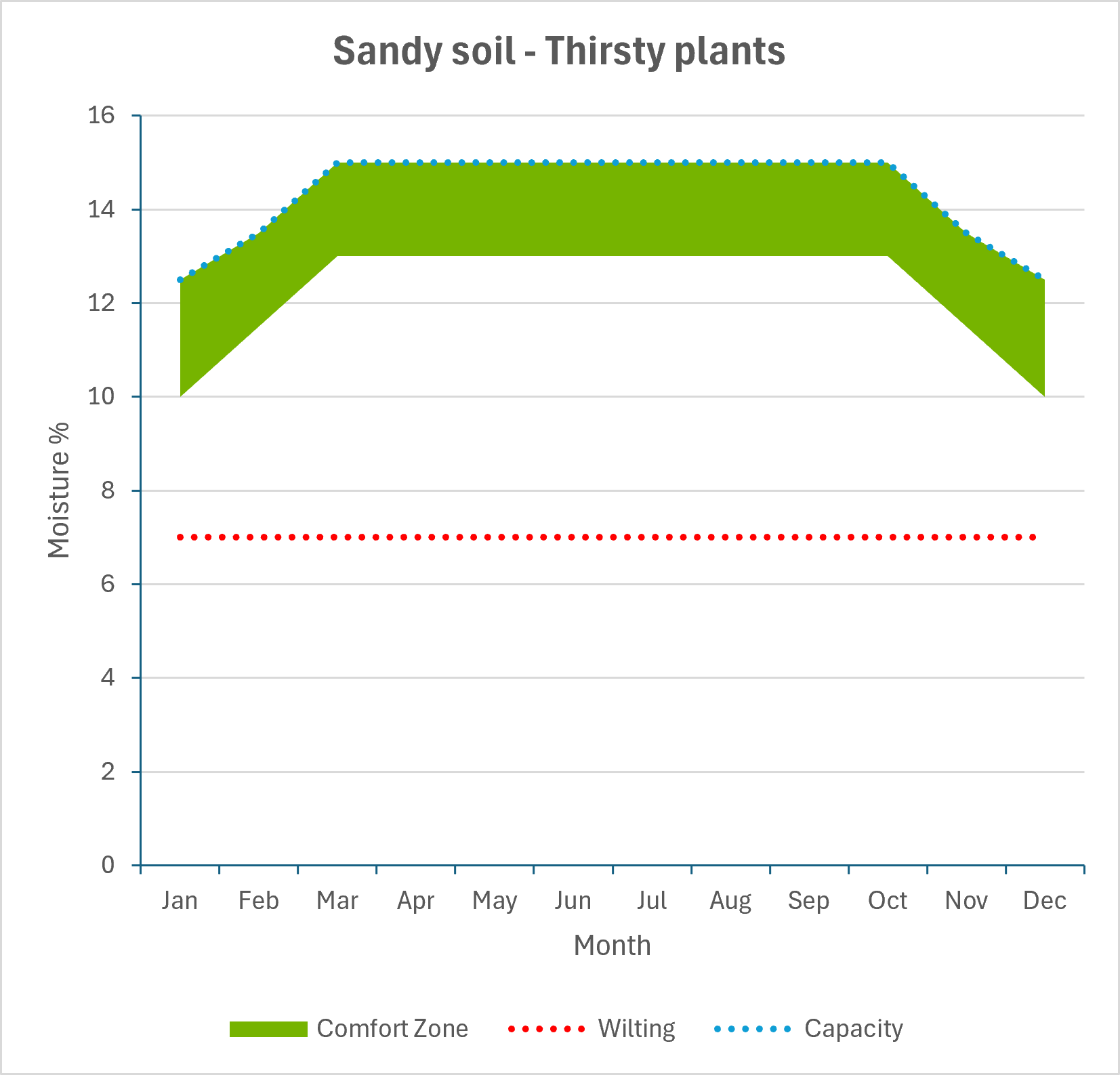
Thirsty plants need more moisture than drought-tolerant plants, and sandy soil loses that moisture quickly. They therefore need more frequent watering, especially during dry summer weather. The green band shows the comfortable moisture range; the red line is the wilting point and the blue line shows the soil's water-holding capacity.
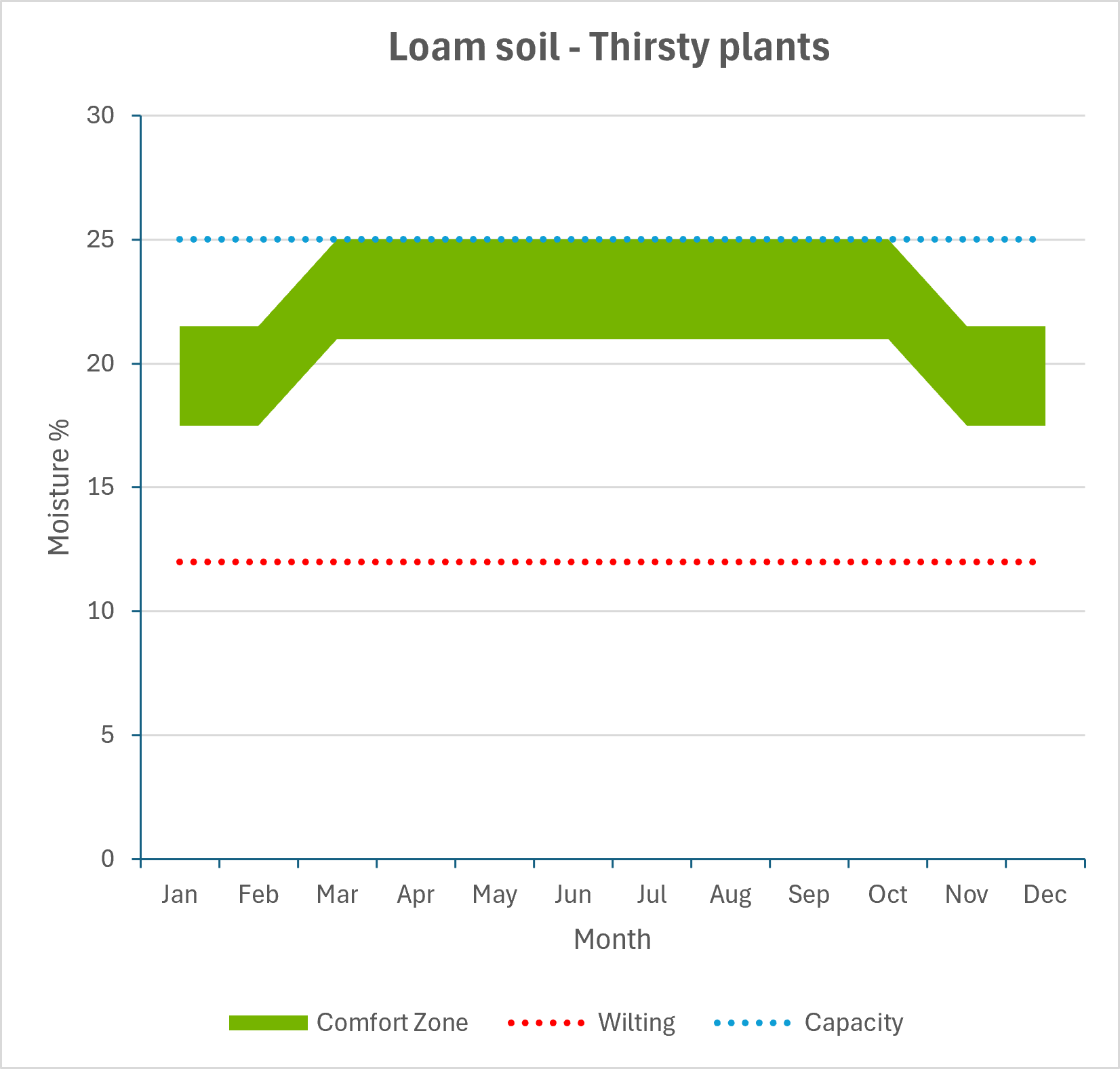
Loam holds more water than sandy soil, making it better suited to thirsty plants. They still need regular watering during dry weather, but generally less frequently than the same plants growing in sandy soil. The green band shows the comfortable moisture range; the red line is the wilting point and the blue line shows the soil's water-holding capacity.
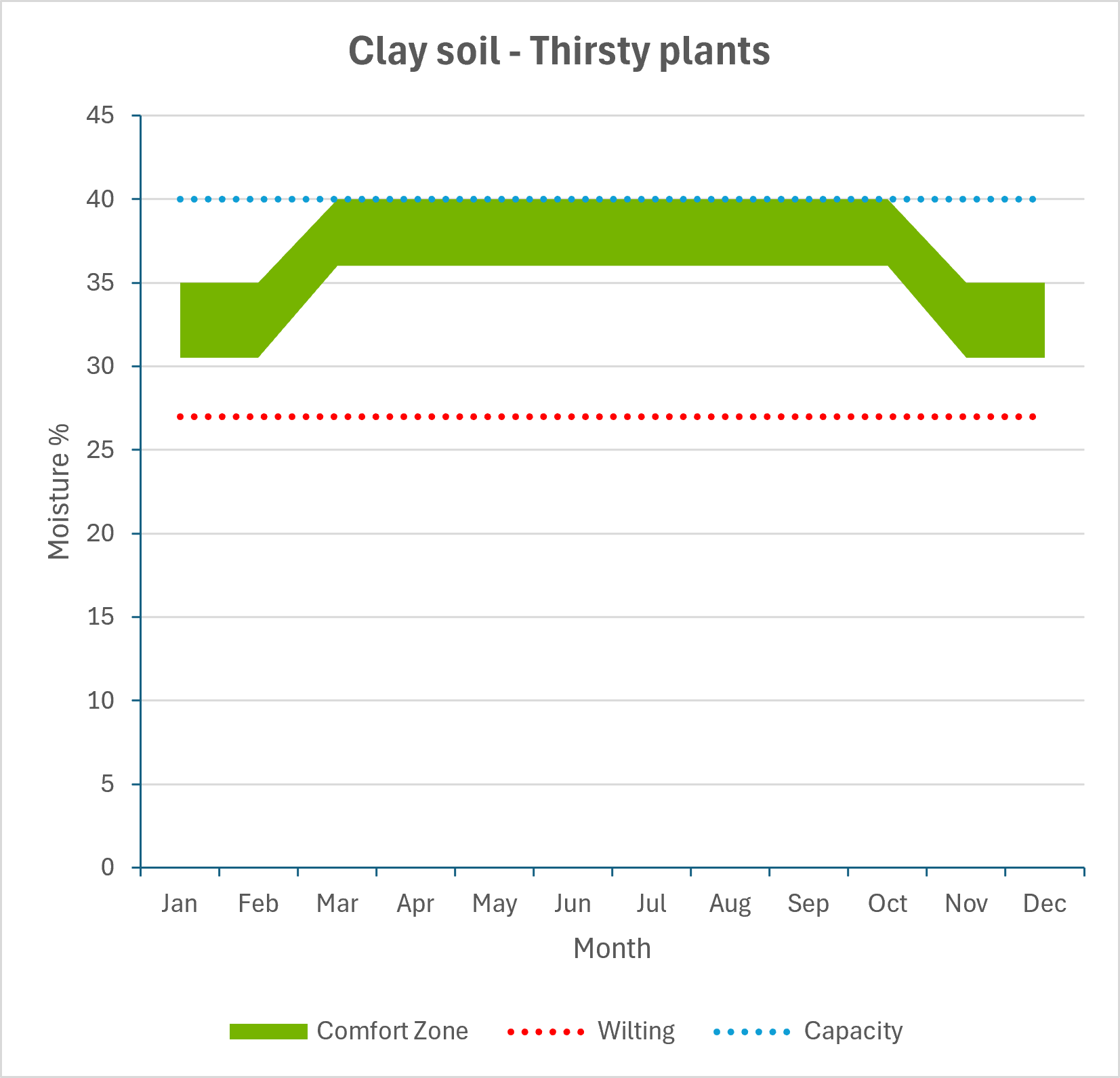
Clay soil holds a lot of water, making it well suited to thirsty plants, but it can also become waterlogged. Water slowly and thoroughly when needed, allowing excess water to drain away rather than watering again while the soil is already saturated. The green band shows the comfortable moisture range; the red line is the wilting point and the blue line shows the soil's water-holding capacity.
Jump to | Top of page | Watering Problems | Watering needs | Soil type impacts | Drought
Feeding your plants when you water
This is an important part of good watering, often forgotten. The wrong type of fertiliser at the wrong time may however make things worse. Some promote leaf growth, others flower growth. A plant can only take up nutrients dissolved in water, so feeding dry soil does very little and can even scorch roots, just like leaves. Water thoroughly first, then feed. Different plants need feeding at different points through the growing season, and the right feed depends on what's actually growing and what your soil needs. See our Fertiliser and Plant Food knowledge page for more information.
Does it matter whether your water supply is hard or soft?
Not for most plants. The vast majority of border plants, vegetables, and lawns tolerate soft or hard water perfectly well.
However - Ericaceous (acid-loving) plants such as camellias, azaleas, rhododendrons, and blueberries need acidic soil (roughly pH 5 to 5.5) to take up nutrients properly. Regular watering with hard tap water can gradually raise the soil pH, particularly in containers. A visible early sign is a white, chalky crust forming on the soil surface or the outside of terracotta pots as the calcium is left behind when water evaporates.
Eventually you will notice leaf yellowing with a very specific pattern. The leaf stem and vein pattern stays green, and the rest of the leaf goes yellow. If not treated, leaf edges will eventually scorch and turn brown, and growth slows. See our Fertiliser and plant food page for how to prevent or treat this problem.
Rain and collected rainwater is naturally soft water and is slightly acidic. A water butt connected to a downpipe is the simplest way to build up a supply for your ericaceous plants.
Watering tools and aids
-
The simplest and cheapest way to reduce both your mains water use and your reliance on hard tap water. A water butt connects to a roof downpipe via a diverter kit, (B&Q or Wicks ~£20). Butts (£30 to £80) can be linked together with a simple connector kit.
Secure the butt on a stand so you can fill a watering can from the tap, and to give enough gravity pressure to attach a short hose or drip line.
A "first flush diverter" diverts the initial, dirtiest run-off from a dry roof away from the butt before allowing cleaner rainwater through. This keeps stored water noticeably cleaner.
-
There are two main types -
1) A network of narrow tubing with small drip emitters positioned at each plant, delivering water slowly and directly to the roots rather than across the whole bed surface. More expensive to install and maintain, but very targeted watering.
2) A “leaky hose” which leaks water across its length by being semi-porous. Easier to install, but waters a wider area of soil along the whole leaky hose length.
In both systems, water is applied slowly at soil level rather than onto foliage. Battery powered timers let the system run automatically at a suitable time of day. This works well for vegetable beds, tomatoes, containers, greenhouses, anywhere with a consistent layout that doesn't change much year to year.
-
Easy to use, but not very water-efficient. Much of the water can evaporate before reaching the soil, or land on paths, patios and other areas where it isn't needed. Sprinklers can be useful for large areas of lawn or planting, but are generally less efficient than watering directly at soil level.
-
A properly stored hose lasts far longer. UV exposure and kinking both shorten a hose's life.
Wall-mounted reels, fixed to an outside wall and connected to the outside tap, make watering easier and keep the hose tidier. Wall-mounted auto-rewinding hose reels cost around £100 to £180 and are available from most garden retailers.
-
If you water the plant roots rather than the leaves, many of the sophisticated (expensive) spray nozzles are not so useful. A long wand that delivers a good flow to the roots may be the best option. The fine sprays are however needed for young seedlings and a widespread area of delicate plants.
-
Hose pipe feeder attachments can draw concentrated liquid feed from a bottle or reservoir and dilute it automatically as water flows through. This helps with larger areas. Dilution ratios are usually fixed by the adapter's design.
-
These systems pair a soil moisture sensor (buried at root depth) with an app-controlled irrigation timer. Rather than watering on a fixed schedule the system only runs when the soil sensor reports watering is needed. One solution for anyone away from the garden often, but expensive and complex to install and maintain.
-
Get somebody else to do your watering professionally! Hortimate offers a holiday garden watering service that looks after the plants with watering and plant feeding.
See our garden watering service for more information.
Jump to | Top of page | Watering Problems | Watering needs | Soil type impacts | Tools |
Drought & Hosepipe Bans
Formally called a Temporary Use Ban (TUB), under Section 76 of the Water Industry Act 1991. Each water company declares its own, based on local water supply conditions. Using a hosepipe, sprinkler, or pressure washer is generally restricted for garden watering, car washing, filling paddling pools or hot tubs, ornamental fountains, cleaning patios or windows.
It is important to check your own water company's rules as they vary between areas. You may still be allowed to use watering cans and buckets and to use water from a water butt. Drip or trickle irrigation systems are sometimes allowed, provided they have a pressure-reducing valve and timer fitted.
Exemptions may include topping up a pond for the welfare of fish or other aquatic animals, or watering newly laid turf. Some companies allow hose watering for the first 28 days after planting. Blue Badge holders and some customers on a Priority Services Register may also be exempt.
If you live in Broadstone, Dorset or close by, see our local watering information page for current rainfall, forecasts and current restrictions.
Saving water
Prioritise. Established trees and shrubs have deep enough roots to survive a dry spell. A brown lawn normally recovers. A newly planted tree that dies doesn't. If you can only water some things, water what you can't easily replace.
Deep, infrequent watering matters even more. A thorough soak followed by time to dry encourages roots to grow downwards, chasing the moisture. Deeper roots make plants more resilient in dry weather. Watering little and often keeps roots shallow, right where the soil dries out fastest.
Water butt use is still allowed even during a full ban, but you must plan ahead and collect water before you need it.
Move containers and hanging baskets to shadier locations or under trees.
Mulch bare soil (Bark, straw, compost) to slow evaporation by up to 60% and reduce how often anything needs watering at all. (Use a 5 to 7 cm of covering)
Specialist garden matting can be used to reduce evaporation around roots. See our suppliers page for sources.
Lawns Play by Different Rules
Everything else on this page has been about watering deliberately and deeply. Lawns are a big exception. The RHS advises - “Resist the urge to water an established lawn at all, even through a full summer drought”.
However brown and dead it looks, a well-established lawn's roots and crowns are usually still alive below the surface, storing enough energy to send up fresh green growth the moment rain returns. The key test is to tug gently on a handful of grass. If it resists held firm by living roots it's likely just dormant, not dead. If it pulls away easily with no resistance at the base, that patch has probably died and will need reseeding once conditions improve.
Mow less often in a drought, and raise the cutting height. Longer grass shades the soil beneath it, slows evaporation, and encourages deeper rooting.
Leave fine lawn clippings on the lawn rather than collecting them as they will act as a light mulch, holding in what moisture there is.
Newly laid or newly sown lawns are different. They need regular watering while establishing, particularly in warm, dry or windy weather. Keep the soil moist without saturating it, then gradually reduce watering as the roots become established.
Wildlife and water in your garden
This page focuses on watering your garden and protecting plants in dry weather. But drought also makes it harder for birds, hedgehogs and pollinating insects to find water. Here's how you can help them and encourage wildlife to come to your garden.
Birds and hedgehogs: a shallow dish of clean water emptied and refilled daily matters. The RHS specifically notes that hedgehogs get just as thirsty as birds in hot weather but have far less ability to find water themselves.
Hygiene matters more than people expect: water left unchanged for days can help spread disease between birds using the same bath. Empty and refill daily, and clean the bath thoroughly at least once a week. A small habit that makes providing water safer for wildlife.
Pollinators need a different setup entirely: bees and butterflies can drown in the same dish that's perfectly safe for a bird. A shallow saucer with a scattering of pebbles or stones gives them somewhere to land and drink safely without the risk.
If you have a pond, an important addition for hedgehog safety is a ramp or sloped exit point. Hedgehogs and other small mammals can fall into steep-sided ponds and drown, unable to climb back out. A simple ramp of stones, wood, or wire mesh at one edge provides an escape route.
Every Hortimate garden survey includes a free hedgehog detection tunnel. Hedgehogs are a helpful natural predator and may feed on slugs and snails. This is covered on our Slugs and Snails page. A garden that's genuinely welcoming to wildlife works in your favour on more than one front at once.
Jump to | Top of page | Watering Problems | Watering needs | Soil type impacts | Tools | Drought