
Jump to | Soil types | Soil layers | Soil maps | Impact of pH | Soil testing | Soil structure | Soil improvement |
Soil types and how to work with them
There are six broad soil types commonly found in gardens: peat, chalk, sand, clay, silt and loam. Most garden soils are mixtures of these. Your soil type, and the layers beneath it, have a big influence on what you can grow successfully, how you water and how you care for your plants. Finding out what you've got is quick and easy using simple tests described below.
Quick Facts
Good growing soil should hold a huge variety of insects and other organisms such as bacteria, fungi and protozoa. The same soil nutrients needed to grow plants also support an incredible ecosystem of other life, making it one of the most biologically dense environments anywhere.
Soil takes roughly 1,000 years to form just one centimetre. It's classified as a non-renewable resource on a human timescale for exactly this reason.
We're losing topsoil 10 to 40 times faster than it naturally forms, according to the Soil Association.
Around 95% of the food we eat is directly or indirectly produced on soil.
The soil right next to a plant's roots can contain up to 1,000 times more microorganisms than the surrounding soil. This narrow zone, called the rhizosphere, is enriched by compounds released from the roots and is a hotspot of microbial activity.
Earthworms are essential for healthy soil. Their tunnels create channels that let air and water penetrate deep into the soil, and their casts (droppings) are nutrient-rich.
Most garden soils are mixtures of sand, silt and clay in different proportions. The balance between them affects how the soil holds water, drains, holds nutrients and behaves when wet or dry.
Soil isn't solid. In a healthy soil, roughly half the volume is pore space — about a quarter air and a quarter water — with the rest made up of minerals and organic matter.
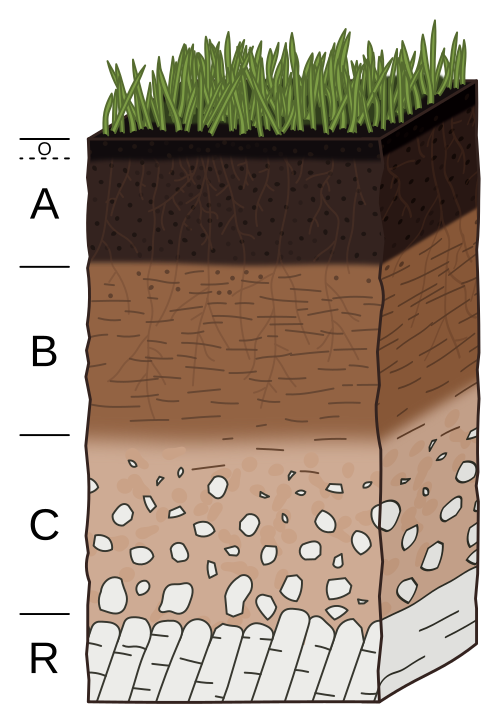
Illustration by Tomáš Kebert & umimeto.org, CC BY-SA 4.0 <https://creativecommons.org/licenses/by-sa/4.0>, via Wikimedia Commons
Jump to | Top | Soil layers | Soil maps | Impact of pH | Soil testing | Soil structure | Soil improvement |
The six soil types and how to identify them
Clay: Particles are very fine, under 2 micrometres (0.002mm). Heavy, dense and excellent at holding both water and nutrients. In summer it can bake hard as concrete shedding water from the surface rather than absorbing it. In winter it can stay waterlogged for long periods.
Silt: Particles between 2 and 50 micrometres. Feels a bit like flour. Fertile, holds moisture well, and drains a little more freely than clay.
Sand: Particles between 50 and 2000 micrometres. Large enough to see and feel individual particles. Light, free-draining and warms up quickly, but holds on to very little water or nutrients. Water can run straight through, taking nutrients with it. Above 2000 micrometers, it’s stones!
Loam: a balanced mix of clay, sand and silt as defined above that holds moisture without waterlogging or drying out too fast.
Peat: Not defined by particle size. Peat contains between 20% and 80% organic matter, and holds huge amounts of water. Usually acidic and relatively low in plant-available nutrients. Peat forms very slowly in waterlogged conditions from partially decomposed plant material.
Chalk: This soil type is defined by its chemical composition. It can have fine or coarse particle sizes largely made up of weathered calcium carbonate (limestone) from the bedrock below. Shallow, stony, and sharply free-draining. Poor water retention, and often drought-prone. Frequently paired with low natural fertility. Usually strongly alkaline.
Adding organic matter such as garden compost, well-rotted manure or leaf mould improves most soils. It helps clay drain better while helping sandy or chalky soil retain more moisture and nutrients.
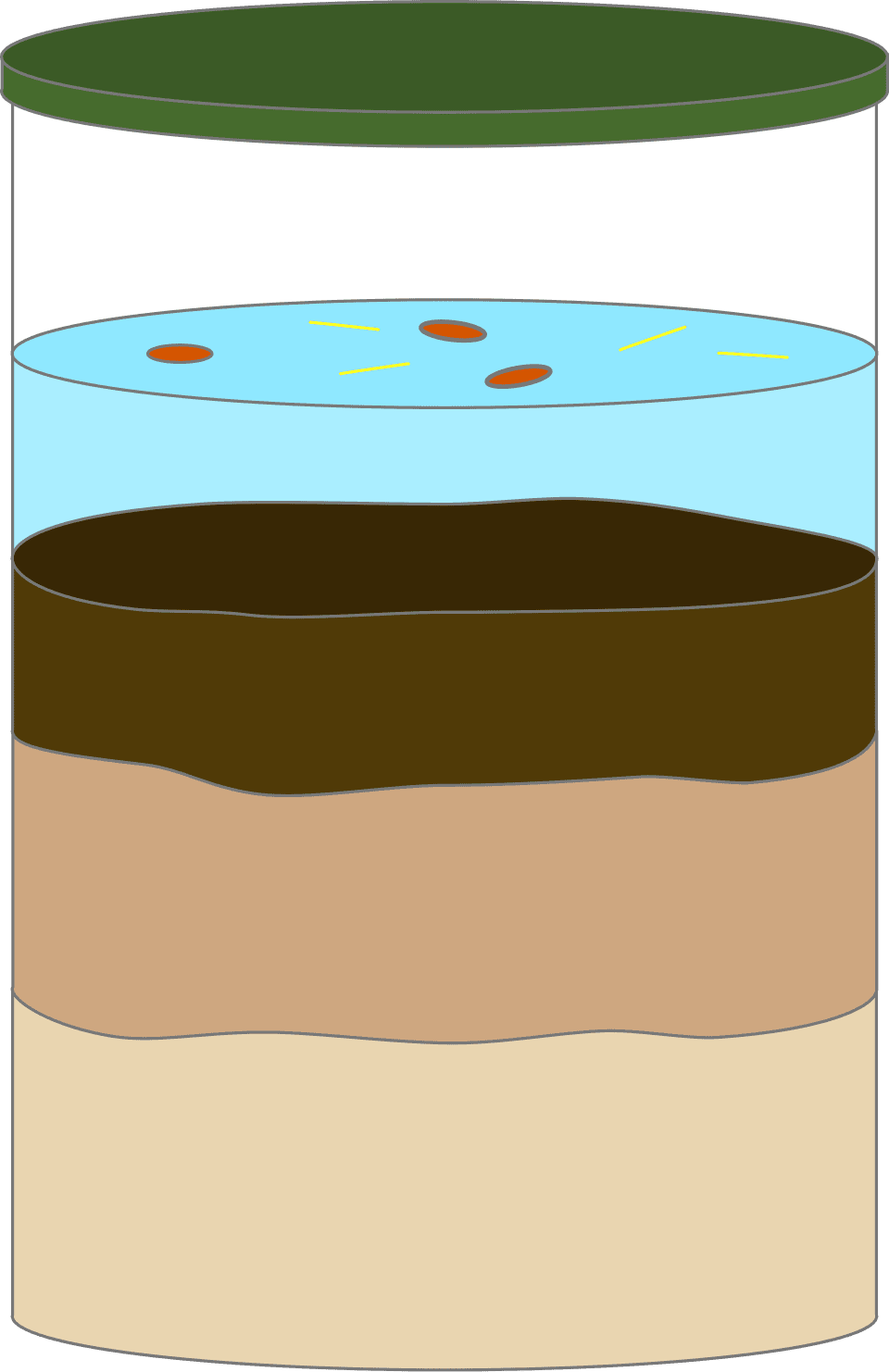
A simple glass jar test will help you work out the proportions of clay silt and sand you have. Fill a clear glass jar a third full of soil. Top up with water and a very small spot of washing-up liquid. Shake well then leave it to settle overnight. Layers will settle out - sand at the bottom, then silt, then clay on top. This simple test will show you the rough proportions of each type in your garden mix.
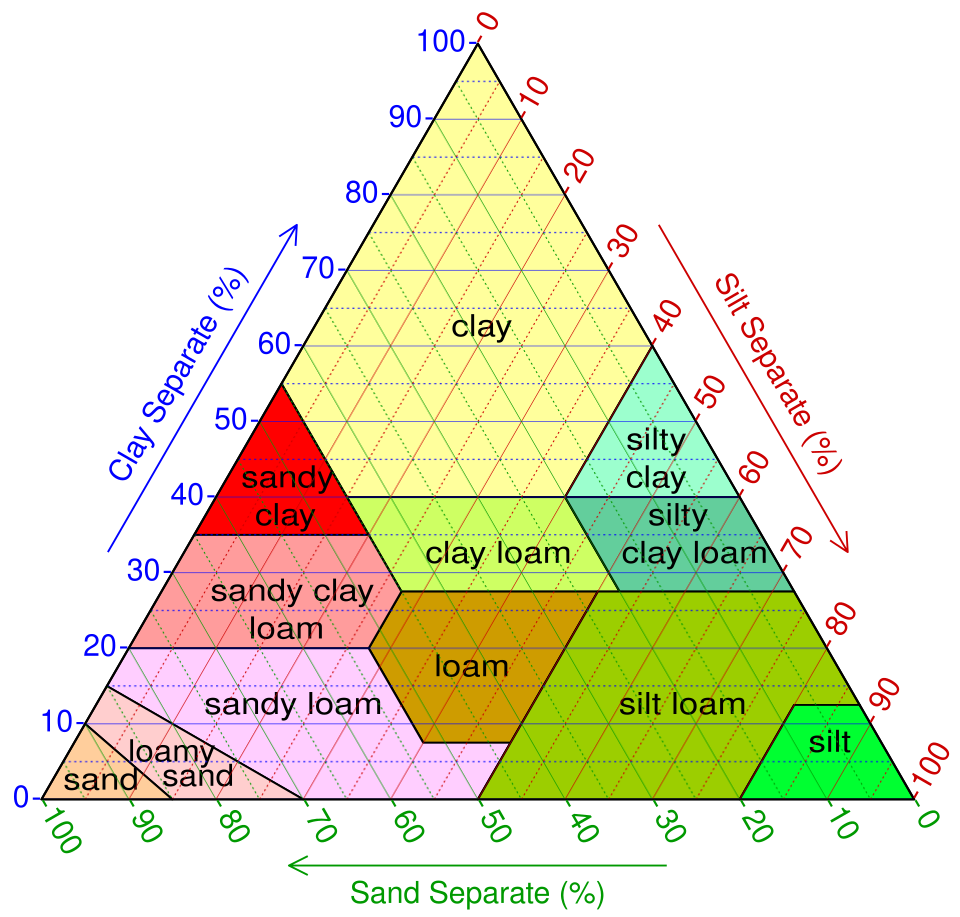
Attribution for diagram - cmglee, Mikenorton, United States Department of Agriculture, CC BY-SA 4.0 <https://creativecommons.org/licenses/by-sa/4.0>, via Wikimedia Commons
This illustration shows the various combinations of clay, sand and silt which helps define your soil type. Use the jar test to work out the % mix in your garden soil. If you live in our service area, Hortimate will do this for you with our free garden survey.
See the British Society of Soil Science for more details on the jar test, and on many other simple experiments that can be carried out in your garden. The “Soil Explorers” page is a good resource for getting children involved!
Jump to | Top | Soil types | Soil maps | Impact of pH | Soil testing | Soil structure | Soil improvement |
Topsoil vs Subsoil — Why the Mix Matters
Topsoil is the upper layer, typically 15–30 cm deep. It's usually darker because it's rich in organic matter, and it's where the overwhelming majority of nutrients, soil life, and plant roots are concentrated.
Subsoil sits beneath it and is usually lighter in colour, denser, and containing very little organic matter. Its role is structural. It provides drainage, physical support, and for deep-rooted plants like trees a reserve of water and minerals to draw on once the topsoil above has dried out.
The relationship between topsoil and subsoil
1. Similar layers, fast or moderate draining. Combinations of sand, chalk and loam.
Combinations of sand, chalk and loam in both layers. Dries out quickly and needs more frequent watering. No reservoir layer to fall back on. Mediterranean and drought-tolerant plants, bulbs, alpines thrive. Thirsty plants struggle without regular irrigation. Nutrients leach through readily. Feed small amounts regularly. Plants vulnerable in drought. Mulching recommended.
2. Similar layers, both slow-draining. Clay and silt layer combinations.
Needs watering less often. The risk is too much water over winter. Moisture-loving plants such as hydrangeas, hostas and other thirsty plants do well. Mediterranean & drought-tolerant plants often resent constantly damp roots. Nutrients hold well with less frequent feeding needed, but waterlogged roots can't always take up what's there. Copes well with short dry spells but needs proper drainage for winter. See our fertiliser knowledge page for more details on plant feeding.
3. Mismatched — free-draining topsoil such as sand or chalk over denser subsoil such as clay
The surface may feel dry and free-draining, leading to frequent watering, but roots may sit in a waterlogged zone just below and out of sight. Shallow-rooted plants can thrive in the loose top layer. Shrubs and trees whose deeper roots reach the trapped-water zone are at real risk of root damage or root rot.
Surface applied feeding can wash straight through without ever reaching root depth, or nutrients can stagnate at a waterlogged boundary instead. Wherever soil has been dug up and put back due to construction work, re-landscaping, or creation of a raised bed, there's a real chance of ending up with free draining soil on top of dense subsoil. The trapped water at boundary depth can, however help plants through a short drought.
4. Mismatched — dense topsoil such as clay or loam over a free-draining subsoil such as sand or chalk
Generally the most forgiving combination. Topsoil holds moisture and nutrients, excess water drains safely away through the subsoil below rather than pooling. A wide range of plants can do well here. Topsoil holds nutrients reasonably well so a normal, moderate feeding routine works. One of the more drought-resilient combinations. There is some water reserve in the topsoil, with no waterlogging risk for roots that reach down into the free-draining subsoil
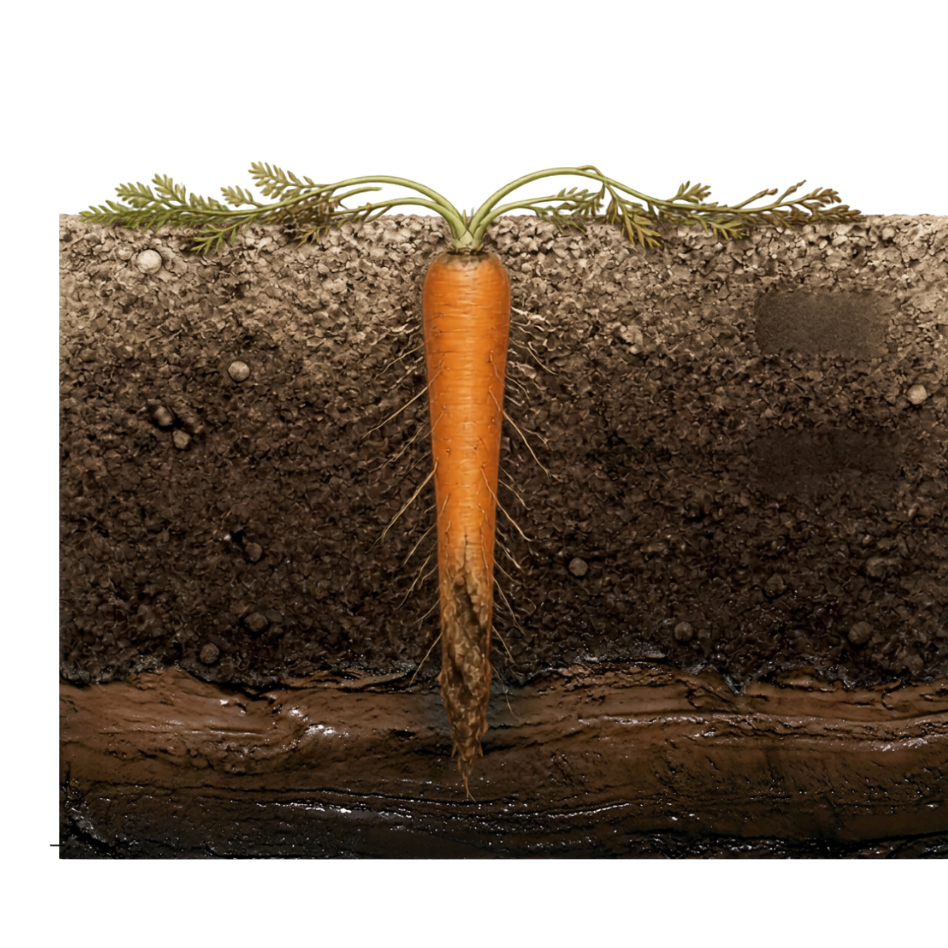
Carrot with dry soil surface, and roots at a waterlogged clay boundary. Dry top and wilting leaves suggest more water, but the real problem is the subsoil boundary.
Soil type maps
Soil type identification can be as simple as the glass jar test described above, or ask for help from an experienced gardener. Hortimate includes a free soil identification and recommendation report for every member. You can go further and carry out a more detailed microscope examination of soil samples. A well balanced soil will usually have a balance between bacteria and fungi. The other option is to look at the online database of soil types across the UK. This will give you a good idea of what to expect, but individual gardens may be different due to landscaping, soil disturbance when created, or other very localised reasons.
The section below gives basic instructions to use the UK soil observatory, a government database showing all aspects of soil composition in use. It’s a bit like the soil equivalent of the Ordnance Survey. It’s free to use for personal use. Look up your garden to see what is revealed!
Jump to | Top | Soil types | Soil layers | Impact of pH | Soil testing | Soil structure | Soil improvement |
How to Use the UK Soil Observatory
The UK Soil Observatory is run by the British Geological Survey and is a free, genuinely powerful interactive map covering soil data across the whole UK. It has a lot of layers, most aimed at farmers and researchers rather than gardeners. Here's how to get useful information out of it without getting lost.
Getting started:
Open the map and use the search or zoom controls to find your own area. You can change the underlying map type from street to topographical using the base-maps tab at the bottom.
Click "External Layers" (or the layers panel button) to open the list of available data layers, grouped by topic.
Click any topic heading to expand it and reveal individual layers — click the "+" next to a layer name to add it to the map.
The layers actually worth looking at, for a home gardener:
mySoil Layer — At the bottom, designed specifically for public, non-specialist use, and the most approachable layer on the whole map if you just want a straightforward answer.
Soil pH, Soil textures, Soil nutrients, Soil moisture — useful general-area layers once you want more detail.
Soilscapes for England and Wales (under "Soil type") — the standard general soil classification for this part of the UK, and the best starting point for understanding your area's typical soil.
Peat Coverage — worth checking if you're near known heathland or wetland areas.
Soil parent - Subsoil description. Fascinating details of soil origins.
Each map has a legend, shown by clicking on the layer icons.
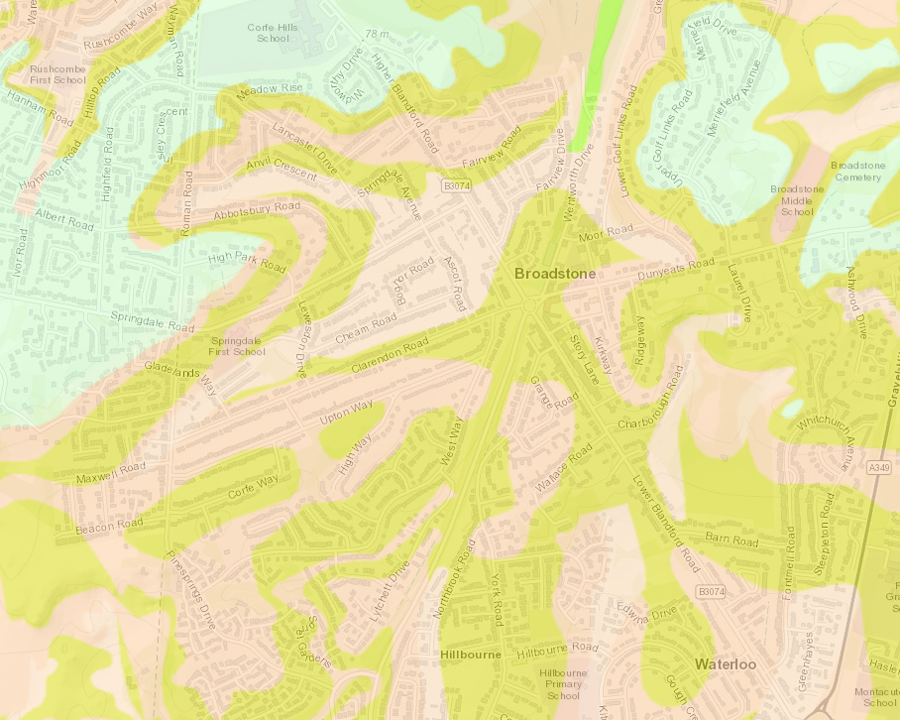
Sample soil type map from UK soil observatory. Visit the soil observatory web site for extensive information on your local soil types.
Jump to | Top | Soil types | Soil layers | Soil maps | Soil testing | Soil structure | Soil improvement |
Soil pH and why it matters - acidic or alkaline soil.
Soil pH is measured on a scale of 0 to14. A measurement of 7 is neutral. Below 7 is acid, above 7 is alkaline. The pH of your soil affects whether the nutrients in your soil are available to be absorbed by the plant roots, or locked into chemical forms that the roots can't absorb. The pH scale is logarithmic, not linear. Each whole-number step is a tenfold change in acidity or alkalinity. A soil at pH 5 isn't slightly more acidic than one at pH 6, it's ten times more acidic. Small differences on a testing kit reading represent much larger real differences than the numbers suggest.
The sections below illustrate some of the problems influenced by soil pH, so its worth knowing your soil.
-
The soil pH controls the pigment-binding reaction, not the plant's basic health
Many big leaf hydrangeas naturally produce pink flowers, but turn blue in acidic soil and stay pink in alkaline soil. Blue colour forms when binding with aluminium ions in a precise ratio. Below pH 5.5, aluminium dissolves into a form roots can absorb; above roughly pH 6.5–7, it binds tightly to soil particles and becomes unavailable, no matter how much aluminium is present in the soil. The flower colour isn't reacting to acidity itself. The pH is simply the switch controlling whether aluminium is available for the plant to take up at all.
-
Camellias, rhododendrons and other ericaceous plants may yellow between the leaf veins in an alkaline soil. This is often a sign of iron deficiency. There may be ample iron in the soil already, but above a certain pH level iron becomes chemically locked into a form roots can't absorb. The pH controls the availability, not the amount of the mineral in the ground.
-
The soil pH will also impact the prevalence of some soil pathogens. Club root disease stunts and deforms brassica roots such as cabbages and broccoli, and is caused by a soil-borne pathogen that thrives in acidic conditions. Liming acidic soil to increase pH before planting brassicas reduces infection risk.
-
Potato scab works the opposite way to club root! A different soil pathogen thrives in alkaline soil, so potatoes are traditionally grown in slightly acidic ground to suppress it. A garden limed for brassicas one year is worse for potatoes the next.
-
Legumes host Rhizobium bacteria in their root nodules. These bacteria take nitrogen from the air in the soil and convert it into forms the plant can use, rather than relying on dissolved soil nitrogen. This bacterial partnership is suppressed in acidic soil and works best closer to neutral pH. A legume struggling in acid soil may be losing its built-in nitrogen supply.
-
Moss tolerates acidic soil far better than grass does. A lawn that's persistently overrun with moss even after physical treatment (scarifying, improving drainage) is often sitting on soil that's simply too acidic for grass to properly outcompete it. This may be a simple thing to check before carrying out expensive drainage work.
For full details on target pH ranges, testing methods, and what happens at the extremes, the RHS's own page on Soil pH and Testing covers it thoroughly.
Testing your soil's pH is included as standard in every Hortimate garden survey alongside soil type identification. Once you know your pH, the next question is what to do about it — adjusting it, or choosing plants suited to what you've got. This is covered on our Fertiliser and Plant Food page.
Jump to | Top | Soil types | Soil layers | Soil maps | Impact of pH | Soil structure | Soil improvement |
Interpreting soil testing results
There are several different soil testing methods with varying accuracy and cost. Soil meters are the most convenient, and chemical tests are often the lowest cost. Chemical-based kits are available on Amazon and most garden centres for about £20. Soil meters vary from £30 to £100s depending on number of factors measured and accuracy.
For a useful basic soil assessment measure soil moisture, soil pH and the three critical nutrients nitrogen (N), phosphorus (P) and potassium (K), often referred to as NPK testing. Nitrogen is essential for leafy green growth. Phosphorus helps the roots, flowering and fruiting, and potassium impacts stem strength, disease resistance and water regulation. Hortimate uses a professional meter to measure these and other factors at several points across a garden.
A useful diagnostic rule: nitrogen, phosphorus and potassium nutrients are all mobile within a plant. A plant can relocate nutrients from older leaves to support new growth when supply is short. Deficiency in any of these three tend to show up on older leaves first. Older leaves may become pale or yellowing, sometimes with a purple tinge for nitrogen specifically. This is the opposite pattern from iron deficiency which shows on the newest leaves first because iron isn't mobile in the same way.
Note that a soil test can show plenty of a nutrient in the soil, but if the wrong pH may lock that nutrient out of an absorbable form. Phosphorus in particular is heavily pH-dependent. A low reading isn't always solved by adding more and sometimes it's solved by adjusting pH instead.
For full deficiency symptoms and what to feed, the RHS's own Nutrient deficiencies page covers this in detail, and our Fertiliser and Plant Food page covers which products supply which nutrient and when to apply them. Every Hortimate garden survey includes pH and NPK testing as standard.
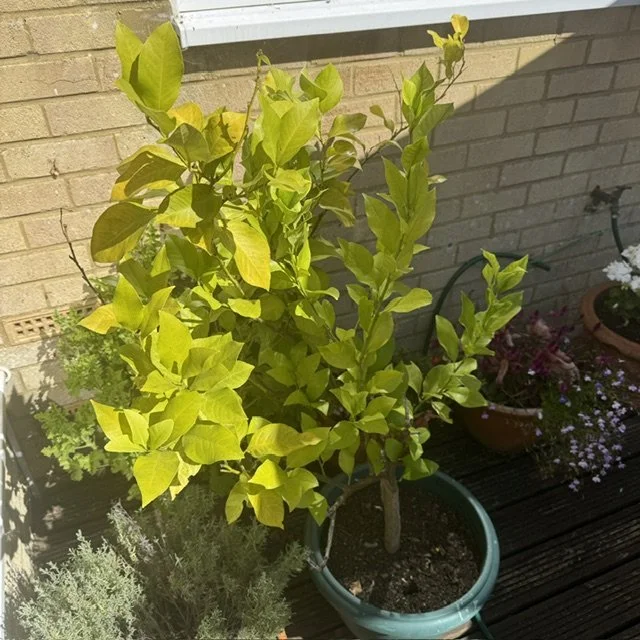
New leaves yellow. Adequate watering, NPK test ok. pH too high.
Jump to | Top | Soil types | Soil layers | Soil maps | Impact of pH | Soil testing | Soil improvement |
Soil Life & Structure
Soil that is just fine particles packed together would prevent oxygen and water flowing freely to the roots. Good growing soil is made from small crumb-like clumps called aggregates. There will be gaps between these clumps, allowing air and water to move through. Aggregate clumps are built biologically with fungal threads, earthworm activity, and sticky compounds released by roots and microbes. These compounds glue soil particles together. Without a steady supply of organic matter feeding that biology, soil gradually loses this structure and reverts to loose, structureless particles. It’s a bit like making an apple crumble. The topping is created with small clumps of flour and butter - but I am not suggesting we rename it as “apple with aggregate topping”.
Compaction is the opposite process. Pressure from feet, wheels, or repeated digging in wet conditions crushes those aggregates and collapses the space between them. Bare soil is especially vulnerable. Rain falling directly on exposed ground breaks down surface aggregates and seals the top into a crust. This is another good reason to mulch your ground. It does more than just conserve moisture.
A simple test for compaction: push a garden wire, thin cane, or screwdriver into moist soil. It should go in 15–20cm without much resistance. If it stops well short of that, the soil beneath is compacted. The fix is biological, not just mechanical. Breaking up compacted soil by digging helps in the short term, but the structure returns to how it was unless the underlying biology is restored. Regular organic matter, avoiding walking on beds when wet, and dedicated paths rather than cutting across borders all help aggregates rebuild and stay intact.
No-dig — protecting the underground network
Digging does more than move soil around. It breaks the fine fungal networks that extend beyond plant roots, disrupts worm channels and damages the natural crumb structure that creates the air and water spaces roots depend on. Repeated cultivation can therefore make it harder for roots to find water, oxygen and nutrients.
A no-dig approach leaves much of this underground network intact. Organic matter such as compost is added at the surface rather than being repeatedly dug in, allowing worms, fungi and other soil organisms to incorporate it naturally. Over time this can improve soil structure, increase biological activity and help plants make better use of the nutrients already present.
No-dig doesn't mean doing nothing. It means improving and feeding the soil from the surface while disturbing the underground system as little as possible.
Improving Your Soil Over Time
Organic matter helps clay drain, sand and chalk hold on to more moisture, rebuilds the aggregate structure, and feeds the soil biology.
Home composting is the cheapest route. Compost success is mostly based on proportions. Roughly a quarter to a half "greens" (grass clippings, vegetable peelings, tea and coffee grounds, soft pruning) and the rest "browns" (torn cardboard, dead stems, chopped woody prunings, autumn leaves). A compost healthy heap doesn't smell bad. If it smells sour or like rubbish, it needs more browns; if it's dry and doing nothing, it needs more greens and some water. Keep out cooked food, meat, fish, perennial weed roots, and diseased material.
Mulching — a layer of compost, bark, or well-rotted manure spread over the soil surface slows evaporation and protects the soil surface from the compaction caused by rain hitting bare ground.
If you'd rather this was simply taken care of, our General Maintenance service covers exactly this kind of ongoing soil improvement work.
Jump to | Top | Soil types | Soil layers | Soil maps | Impact of pH | Soil testing | Soil structure |
All Hortimate customers in the BH18 Broadstone, Poole, Dorset area can book a free garden survey and soil test, measuring pH, NKP, moisture, soil and subsoil types in up to 4 locations, with a detailed report and planting recommendation..