
Wessex Water hosepipe bans covering the Broadstone BH18 area.
What does the hosepipe ban mean for Broadstone?
From Tuesday 18 August 2026, Wessex Water's Temporary Use Ban (TUB) restricts hosepipes for watering gardens, lawns, flowers and plants across the region.
You can still water your garden without a hosepipe, including with watering cans or buckets. Water collected in a water butt can also be used. Wessex Water has published exemptions for certain health, safety, animal-welfare and other circumstances, so check its current rules before assuming an exemption applies.
For Broadstone gardeners, watering a garden means carrying water by hand or finding another permitted method. Despite recent rain, containers, hanging baskets and newly planted plants may need attention. Established beds and shrubs should increasingly be self sufficient as we go into Autumn.
Our Aquist watering service can still help you during a hosepipe ban by using legal methods permitted under the current rules. Contact us if you need help.
Broadstone water supply and hardness.
Broadstone's water supply comes from Wessex Water. The area is on the boundary with Bournemouth water, which may have different drought restrictions. See the map for details of who supplies your water.
Broadstone tap water is hard. Wessex Water's results for BH18 8AQ show 286.4 mg/l of calcium carbonate. Hardness can vary between local supply areas, so check the water quality for your own property using Wessex Water's postcode checker.
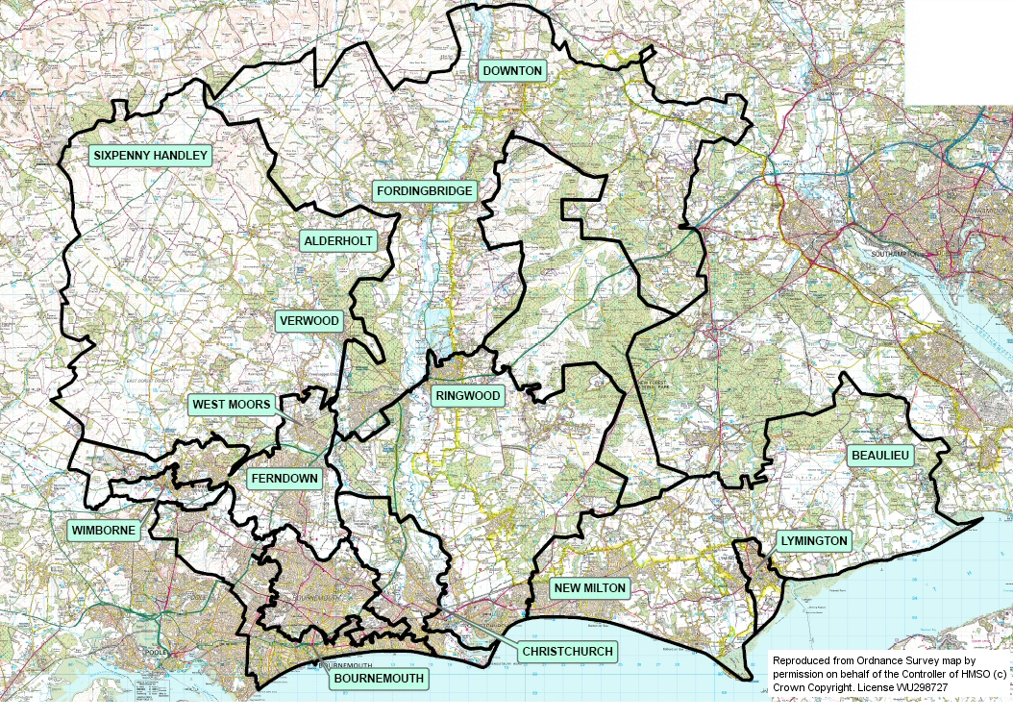
Map showing boundary between Wessex water and Bournemouth water areas
Does it matter whether your water supply is hard or soft?
For most garden plants, no. The vast majority of border plants, vegetables and lawns tolerate either hard or soft water well. However, acid-loving (ericaceous) plants such as camellias, azaleas, rhododendrons and blueberries need acidic soil to take up nutrients properly. If irrigation water is alkaline, repeated use may gradually increase soil pH, particularly in containers and other situations where there is little opportunity for minerals to be washed away. A water butt provides naturally soft rainwater and is particularly useful for acid-loving plants.
If you are seeing yellowing leaves with green veins on an acid-loving plant, check the soil pH rather than assuming the problem is simply lack of fertiliser.
Last 12 months of rainfall data at the Hurn Meteorological station
2026 has been a rollercoaster year in Dorset for rainfall.
January: exceptionally wet with 210mm of rainfall.
February was the 9th wettest on record (140mm 210% of average).
Spring turned much drier: the April–June period came in at only 76% of the long-term average.
June 2026: 54.6mm, but nearly all of it fell in the first 10 days and the rest of June was largely dry.
July 2026: rainfall fell to virtually zero at Hurn, following an already very dry spring and early summer. The prolonged dry weather and heat put considerable stress on gardens, crops and natural vegetation across Dorset, with some local agricultural harvesting taking place earlier than usual.
August had about half the long term average rainfall.
So far, September is a bit below average rainfall.
Rainfall 2025/2026 (Hurn Met station)
Hurn provides a useful local rainfall record for Broadstone, but rainfall across the wider Wessex Water supply region can be quite different. Water-resource figures for the Wessex region quoted below refer specifically to the Wessex Water supply region and should not be interpreted as Broadstone rainfall measurements.
Met Office 28-day weather outlook for Broadstone (BH18)
Current outlook: Updated 17th Sept 2026
The first part of this period will likely see a build of pressure across much of the UK, with Atlantic weather fronts becoming more confined to the far north west. As such, plenty of dry and increasingly warm and perhaps rather humid weather will develop over the latter part of September, with temperatures dropping to near normal by the end of the month.
Early October may be changeable with unsettled weather becoming more frequent. Periods of rain and stronger winds may become more likely from the west, although with some transient drier and brighter spells. Deeper low pressure systems could bring occasional periods of very strong winds. Temperatures are likely to remain above normal overall, though brief cooler interludes are also possible.
What this could mean for your garden:
After the exceptionally dry July and August, any rain that falls will be soaked up quickly by the parched ground, but the water table will still be very low. Gardeners should expect watering to remain important, particularly for containers, newly planted plants, vegetables and other vulnerable plants. Frequent heavy showers will gradually reduce need for regular deep watering.
Updated: 17 Sept 2026
ECMWF outlook 17/9/26 to 31/10/26
ECMWF is the European Centre for Medium-range Weather Forecasts.
The ECMWF outlook suggests temperatures are likely to remain above the seasonal average through the period, but varies with the forecast week.
Rainfall is less clear. The ECMWF suggests no strong indication of a prolonged dry or exceptionally wet period for Dorset over the coming weeks, with rainfall potentially fluctuating around the seasonal norm. Periods of useful rainfall are likely, but the outlook does not currently provide evidence of a sustained return to the wet conditions that would rapidly reverse the water-resource deficit.
View the latest ECMWF long-range forecast — temperature
View the ECMWF rainfall outlook — precipitation
El Nino - An important influence on our weather
The 2026 El Niño is developing into an exceptionally strong event. The Met Office describes it as potentially the largest El Niño in living memory, with its models showing Pacific sea-surface temperature anomalies potentially exceeding 3°C in the Niño 3.4 region.
El Niño's effects on the UK are indirect, but historical El Niño events have been associated with warmer, wetter and windier conditions across the UK and northern Europe during late autumn and early winter. The latest Met Office seasonal outlook currently puts the likelihood of a warm and wet UK autumn at around 1.5–2 times normal, with an increased likelihood of windy conditions later in the season.
The developing El Niño is expected to strengthen through autumn before reaching its peak during winter. However, El Niño is only one of several influences on UK weather, so it changes the probabilities rather than providing a prediction of the weather that will actually occur.
Drought update
The low rainfall over the summer has created significant stored water shortfall. About 75% of Wessex waters supply comes from ground water extraction, and the other 25% from reservoirs. Stored water capacity is normally at an annual low point in September/October, and reaches a high point in February/March. Reservoir capacity recovers much more quickly than groundwater levels.
Wessex water reservoirs are currently below the long term September average with only 36% of capacity. The typical September/October seasonal low is typically about 45% to 60% capacity.
Groundwater is also below the long term average, but needs more sustained long term rainfall to recover. The ground is very dry to depth, and rainfall will initially be soaked up before aquifers refill.
Will there be a hosepipe ban next year?
Reservoirs are at 36% capacity. Groundwater is significantly below its long-term average. March–August rainfall was only 61% of normal. This winters rainfall profile will be critical.
Here are some Hortimate scenarios based on Wessex water published data.
1) Average winter rainfall spread over the period October to March 27.
The combined March–August and October–March rainfall would be only about 80% of normal. We would enter spring 27 with low reserves, and a relatively dry summer in 2027 would most likely result in further restrictions.
2) Wetter than average autumn as suggested by the El Nino forecast, followed by average rainfall in Jan/Feb/Mar 27.
The reservoirs should recover quickly (25% of total Wessex supply), but groundwater may not fully recover, and we could enter spring with lower reserves.
3) Winter with above average rainfall over the full period.
120% of average winter rainfall would bring us up to about 91% over the 12 month period. Nearly 140% above winter average would be needed to reach 100% of annual rainfall..
4) Drier than average winter.
We will probably be in trouble, with water use restrictions required to maintain essential supply through the summer.
The prospects for gardeners getting relief from watering this autumn look better than they did in July, but there is not yet enough evidence to say whether hosepipe restrictions will still be necessary next spring or summer. The key period will be the accumulated rainfall and groundwater recovery over the winter.
What should Broadstone gardeners do to prepare?
The immediate priority is to make the most of autumn rainfall and reduce dependence on mains water next year. Install or increase your water-butt capacity now. Autumn and winter are the best opportunity to collect rainwater for use during future dry periods. Even a modest storage capacity can provide a useful reserve for containers, hanging baskets and newly planted plants.
If you would like more advice on garden watering generally, see our knowledge page.
If you would like help with garden watering see our Aquist garden watering service page.